
Citadel of Aleppo
Aleppo, Syria · The crown of Aleppo al-Shahba
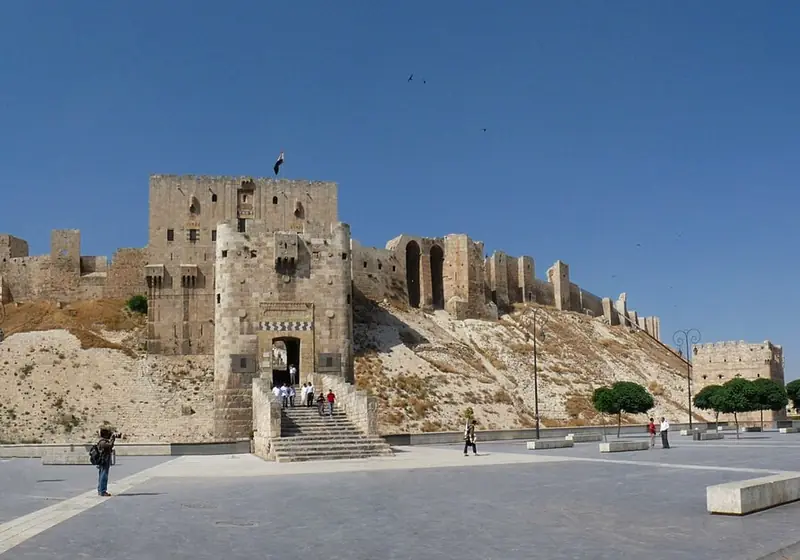
One of the oldest and largest citadels in the world, a witness to Islamic military architecture of the Ayyubid and Mamluk eras.
Did you know?
- It stands on a mound in the heart of Aleppo, surrounded by a wide moat and towering walls.
- Its entrance is a raised stone bridge ending in a massive gate, one of the most famous military entrances in Islamic architecture.
- Al-Malik al-Zahir Ghazi, son of Salah al-Din, refortified it, and the Mamluks added the great entrance tower.
- It contains two mosques, one of which is attributed by inherited tradition to Ibrahim, peace be upon him.
History and architecture
The Citadel of Aleppo rises on a mound at the center of the city, inhabited by people for thousands of years. But the image we see today was shaped by the Islamic eras. Al-Malik al-Zahir Ghazi, son of Salah al-Din, made it an impregnable fortress: he deepened the moat, faced the slopes with stone and built palaces, mosques and storehouses inside. Then the Mamluks built the massive entrance tower that greets the visitor after climbing a long stone bridge. The citadel withstood many sieges and suffered damage from wars and earthquakes, and restoration work continues. It remains the symbol of Aleppo al-Shahba, visible from all its old quarters. Inside are the Mamluk throne hall with its decorated wooden ceiling, a bathhouse, storehouses and wells, making it a small city able to hold out for a long time.
Founded: A site inhabited for thousands of years; its standing fortifications are Ayyubid and Mamluk, most notably under al-Zahir Ghazi around 600 AH / 1200 CE
Religious significance
A witness to the Islamic military architecture that protected the cities of the Levant during the Crusades and the Mongol invasions.
It contains mosques within its walls, reflecting the presence of prayer even at the heart of fortresses.
Allah says: “Have they not traveled through the land and observed how was the end of those before them?” (Ar-Rum 30:9).
Visiting tips
- Best time: At sunset, when the golden stones glow. Check the current situation and travel advice before visiting.
- Photography: From the square facing the entrance, to capture the stone bridge and the gate tower together.
- Nearby: The Great Umayyad Mosque of Aleppo, Al-Madina Souq, Khan al-Wazir

Explore Islamic places in the app
Muflihin Pro brings Islamic places, the Quran, adhkar, prayer times and Qibla together in one app. Free on Google Play.
Get it on Google PlayFrequently asked questions
Where is Citadel of Aleppo?
Citadel of Aleppo is in Aleppo, Syria.
When was Citadel of Aleppo founded?
A site inhabited for thousands of years; its standing fortifications are Ayyubid and Mamluk, most notably under al-Zahir Ghazi around 600 AH / 1200 CE