
The Alhambra
Granada, Spain · “There is no victor but Allah”, carved upon its walls
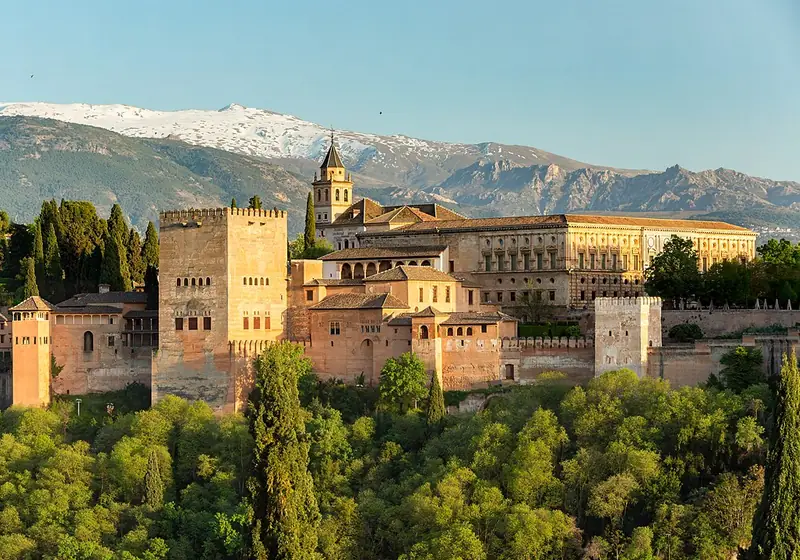
The jewel of Andalusian architecture, known for its fine carvings and enchanting geometric ornament, the height of Islamic art in al-Andalus.
Did you know?
- The phrase “There is no victor but Allah”, the motto of the Nasrids, is repeated on its walls in countless places.
- In the Court of the Lions stands a fountain carried by twelve marble lions, one of the most famous fountains in the world.
- The ceilings of its halls are adorned with thousands of muqarnas, resembling honeycombs or hanging stars.
- Granada was the last stronghold of the Muslims in al-Andalus, and it was surrendered in 897 AH / 1492 CE.
History and architecture
On a hill overlooking Granada, Muhammad ibn al-Ahmar, founder of the Nasrid dynasty, began building the Alhambra as a fortress and palace. In the fourteenth century the sultans Yusuf I and Muhammad V turned it into an architectural masterpiece: courtyards with pools and fountains at their center, halls whose walls are covered with carvings, verses and poetry, and ceilings of muqarnas in which the light glitters. The poet Ibn Zamrak wrote verses that were carved on the walls, as if the palace were speaking of itself. When Granada fell in 1492 CE, its last king, Abu Abdullah, handed over the keys of the city, closing eight centuries of Islamic civilization in al-Andalus, and the Alhambra remained as a witness to what once was. The palaces are surrounded by the gardens of the Generalife, where water flows in fine channels brought from the mountains by an ingenious Andalusian irrigation system.
Founded: Construction began around 635 AH / 1238 CE and reached its peak in the 8th century AH / 14th century CE
Religious significance
It is not a place of worship, but it is one of the greatest witnesses to Islamic civilization in Europe, with Qur'anic verses carved on its walls.
Its motto, “There is no victor but Allah”, is a constant reminder that might belongs to Allah alone, however great a man's kingdom.
Allah says: “And these days We alternate among people” (Al Imran 3:140), and the story of Granada is a living witness to this law.
Visiting tips
- Best time: Book your ticket weeks in advance, as entry to the Nasrid Palaces is by timed slot; early morning is the calmest time.
- Photography: From the Mirador de San Nicolás in the Albaicín at sunset, when the palace glows against the Sierra Nevada.
- Nearby: Generalife, Albaicín quarter, The Arab baths (El Bañuelo)

Explore Islamic places in the app
Muflihin Pro brings Islamic places, the Quran, adhkar, prayer times and Qibla together in one app. Free on Google Play.
Get it on Google PlayFrequently asked questions
Where is The Alhambra?
The Alhambra is in Granada, Spain.
When was The Alhambra founded?
Construction began around 635 AH / 1238 CE and reached its peak in the 8th century AH / 14th century CE