
Taj Mahal
Agra, India · White marble that changes color with the hours of the day
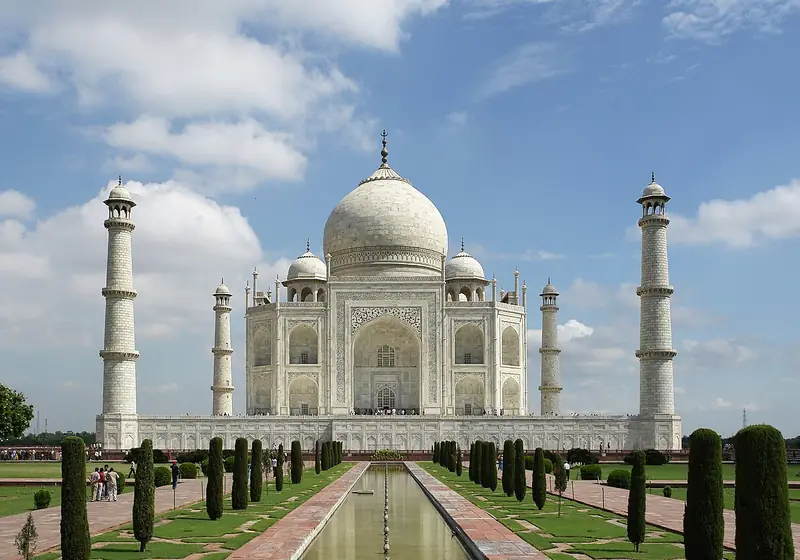
A white marble mausoleum built by the Mughal emperor Shah Jahan, counted among the wonders of the world and the finest example of Mughal architecture.
Did you know?
- The Mughal emperor Shah Jahan built it as a mausoleum for his wife Mumtaz Mahal.
- Its gateway and walls are adorned with Qur'anic verses in thuluth script, executed by the calligrapher Amanat Khan.
- Its marble shifts from pink at dawn to white at noon and gold under the moonlight.
- To its west stands a red sandstone mosque, and the site is closed to visitors on Fridays except for worshippers.
History and architecture
When Mumtaz Mahal, wife of Emperor Shah Jahan, died, he resolved to build her a tomb without equal on the banks of the Yamuna River. Around twenty thousand workers and craftsmen labored for nearly twenty years, and white marble was brought from far away. The design is symmetrical with astonishing precision: a great onion dome, four minarets, and gardens divided into four parts by channels of water. The walls were inlaid with colored stones forming flowers, and Qur'anic verses were written on them in a script that grows larger as it rises, so that it looks even to a viewer standing below. The Taj Mahal became a symbol of India and one of the most famous Islamic monuments in the world. Shah Jahan spent his final years confined in Agra Fort by order of his son Aurangzeb, gazing at the Taj from his window, and was later buried inside it beside his wife.
Founded: Around 1042–1063 AH / 1632–1653 CE
Religious significance
It is not a mosque or a place of worship but a funerary masterpiece; prayers are held in the mosque attached to it, west of the mausoleum.
The Sunnah for graves is to keep them level and not build over them, as “the Messenger of Allah ﷺ forbade plastering graves and building over them” (Muslim), so the place is visited to reflect on its art and to take a lesson.
Its walls bear verses of the Noble Qur'an, including Surah Ya-Sin, reminding of the Hereafter and that everything on earth will perish.
Visiting tips
- Best time: At sunrise, before the crowds and the heat. The site is closed to tourists on Fridays.
- Photography: From the central water channel to capture the full reflection, or from the Mehtab Bagh garden on the opposite bank at sunset.
- Nearby: Agra Fort, Fatehpur Sikri, Tomb of I'timad-ud-Daulah

Explore Islamic places in the app
Muflihin Pro brings Islamic places, the Quran, adhkar, prayer times and Qibla together in one app. Free on Google Play.
Get it on Google PlayFrequently asked questions
Where is Taj Mahal?
Taj Mahal is in Agra, India.
When was Taj Mahal founded?
Around 1042–1063 AH / 1632–1653 CE